
Makhana Roasting Machine: Price, Types and How to Buy the Right One in India
Three hours at a hot kadhai. Non-stop stirring. Smoke in your eyes, back aching, and at the end half your makhana is overdone and the other half still chewy. Sounds familiar?
If you run a small roasting setup, you know this pain very well. And you also know the worst part: you can't even blame the worker. Hand roasting just doesn't stay the same from batch to batch. A makhana roasting machine is the fix most people end up going for, sooner or later.
Makhana is big business now. Bihar has the farms, Darbhanga and Madhubani and Purnia are famous for it, but the buyers sit all over. Delhi, Punjab, Mumbai, even Dubai. They all want crisp, evenly roasted pops in a clean pack. Every time. No excuses.
So here's a plain guide on types, cost, suppliers and the mistakes to dodge. And if you get stuck anywhere, blacknut.co.in is where you can ask.
Why Roasted Makhana Is in Demand Right Now
Ten years back, makhana was something you saw in kheer and during fasts. Now it sits in gym bags and office drawers. People want a light snack that isn't fried, and makhana fits. Mithila makhana even got a GI tag a few years ago, which pushed the name further.
Festive and fasting seasons are the real rush. Navratri, Karwa Chauth, Diwali gifting. Orders jump and you can't just tell buyers to wait a week. This is exactly when a hand setup breaks down, because you can't suddenly make ten more workers appear.
Flavoured makhana is the other trend. Peri peri, cheese, pudina, plain salted. All of it starts with a proper base roast. If the base roast is off, no masala can save it.
Why Hand Roasting Stops Working
For home use, hand roasting is perfectly fine. A kilo here, two kilos there, no problem. Taste is great too, nobody argues with that.
Trouble starts when orders pick up. One person can only stand at the kadhai for so long. By evening the hands are slow, the heat is all over the place, and you get more burnt pieces. Wastage goes up quietly and you don't notice until month-end.
Some things you probably face already:
Colour is uneven, dark and pale pops in one packet
Gas or wood burns like crazy
Output drops after lunch
Retailer asks for 200 kg and you panic
A makhana roasting machine takes care of most of this. Same heat, same time, same result. Morning or night, doesn't matter.
How a Makhana Roasting Machine Works
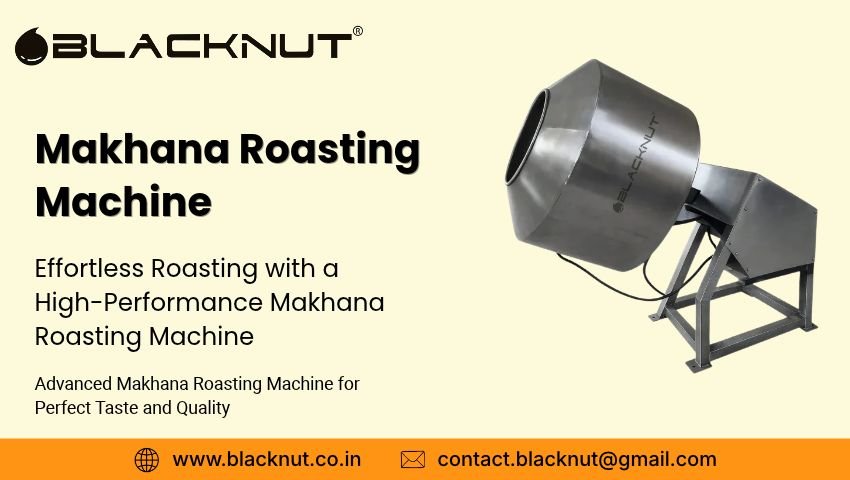
Idea is very simple. Makhana goes into a drum or a tray that keeps rotating. Heat comes from electric rods, a gas burner, or both. Since the drum never stops turning, every pop gets the same heat. Every makhana roasting machine you will see is built on this one idea, whatever the brand.
Basic parts, nothing fancy:
Steel drum
Heater (electric or gas)
Motor and gearbox
Temperature controller
Timer
Door at the bottom or side to take out the roasted makhana
You fill it, set the temp, set the timer, press start. After roasting you tip it out and let it cool a bit, then it moves to flavouring or packing.
One thing people skip: speed control. A machine where you can slow the drum down is gentler on the pops. Fewer broken pieces, and broken makhana sells for much less.
Types You Will Find in India
A makhana roasting machine comes in a few styles. Don't get dazzled by photos. Choose by how many kilos you roast in a day.
The Automatic Makhana Roasting Machine is what most growing units go for. Load it, set temperature and time, walk away. Many models switch off by themselves when the timer ends, so a batch doesn't burn just because you got a phone call.
Other types around:
Manual drum roaster: cheap, basic motor, fine for tiny setups
Semi-automatic: you load and unload, machine handles heat and rotation
Gas roaster: running cost is lower if gas is easy to get
Electric roaster: cleaner and easier to control
Continuous line with a conveyor: for big factories only
Power cuts happen a lot in many parts of Bihar. If that's your area, think about a gas or hybrid model. Otherwise you'll be sitting idle with a full batch inside.
Gas, Electric or Hybrid: Picking the Heat Source
This one decides your monthly bill, so think about it properly.
Gas heating is quick and cheap to run when LPG or PNG is easy to get. Heat-up time is short. But the flame needs watching, and temperature control is rougher unless the model has good burners.
Electric heating is cleaner and the temperature stays steadier. Good for indoor units and neat packing rooms. Downside, the power bill, and in places with long cuts you're stuck.
Hybrid models run on both. They cost more upfront, but if your area has shaky power, it's the safer bet. You can switch when needed and the work continues.
Ask the supplier for the actual consumption per hour, not a vague line like "low power use". Numbers please.
Cost of an Automatic Makhana Roasting Machine in India
Everyone asks this first, so let's get to it.
The Makhana Roasting Machine Price changes with capacity, steel quality, heating type and how much automation you want. No fixed rate, sorry. But roughly:
Small manual or semi-automatic units: ₹40,000 to ₹1,50,000
Mid-size automatic units (20 to 50 kg per batch): ₹1.5 lakh to ₹5 lakh
Big industrial lines: ₹10 lakh and above
Take these as ballpark only. Final quote moves with steel grade, brand, freight and GST.
What pushes the cost up?
Food-grade stainless steel instead of mild steel
Digital panel
Bigger drum
Cooling or seasoning drum as add-on
Installation and training
Cheapest quote is rarely the best deal. A machine that burns pops or dies in six months will cost you double. Get warranty and service terms in writing, and ask how much power or gas it eats per hour.
Running cost is part of the price even if the quotation doesn't say so. Payback depends on your volume and selling rate, so work it out with your own figures.
Makhana Roasting Machine for Small Business
Not everybody needs a factory. Maybe you're starting from a village in Bihar, a small shop in Punjab or a home brand in Delhi NCR. A compact roaster is enough then.
A Makhana Roasting Machine for Small Business should be small, easy to wash and simple enough for one person. 5 to 20 kg per batch is usually plenty when you're starting.
Check these:
Fits in a normal room
Runs on single-phase power
Easy to clean (hygiene matters from day one)
Spare parts easy to get
Can be upgraded later
Start small, see how the market reacts, then grow. Many first-timers buy a giant machine and then it sits half empty. Don't do that.
Confused about size? Send your daily quantity and budget to the team at blacknut.co.in. They'll suggest what fits, no pressure.
Commercial and Industrial Roasters: What Changes
A Commercial Makhana Roasting Machine is made to run many hours every day. Bigger drum, stronger motor, body that can take a beating. Packers, wholesalers and snack brands usually buy this kind.
Go one step higher and you get the Industrial Makhana Roasting Machine. Factory stuff. Conveyors, auto feeding, cooling units, digital panels, hundreds of kilos in a shift.
At this scale you also have to think about:
Food-grade steel that's easy to wash
Batch temperature records
Heavier power or gas load
More floor space
Trained operators
Selling to big retailers or exporting? Then hygiene matters even more. Buyers will ask for your FSSAI licence and want to see clean processes. Food-grade stainless steel makes that part easier.
Where to Find Suppliers of Industrial Makhana Roasters
Finding a good supplier is harder than finding a machine. A lot of sellers online are just traders, not makers. Big difference when something breaks.
A real Makhana Roasting Machine Manufacturer has their own workshop, can change the design for you and stands behind the machine after sale. Ask for factory photos, a running video, and numbers of people already using it.
A Makhana Roasting Machine Supplier in India could be a maker or just a dealer. Both can work. Just ask who does the repair. If the dealer sells and the maker sits in another state, a small spare part can take weeks.
Where to look:
Direct manufacturers like blacknut.co.in
Food machinery hubs in Punjab, Haryana, Delhi NCR and Gujarat
Online B2B listings (check every seller yourself)
Food processing expos
Makhana farmer groups in Bihar, ask what they use and if they're happy
Before paying any advance:
Visit or do a video call
Watch it run with real makhana
Get specs and price in writing
Confirm warranty and service
Talk to two buyers who already own one
Quick Checklist Before You Buy
Save it on your phone and read it out at the supplier's office.
Daily quantity. Know your kilos first.
Power or gas at your place.
Food-grade steel wherever makhana touches.
Digital temperature control if you can afford it.
Easy cleaning. Can you open the drum fully?
Who fixes it in peak season?
Warranty in writing.
Trial run with your own makhana
Save it on your phone and read it out at the supplier's office.
Roasting Is Only Half the Job
Once the makhana is out of the drum, don't pack it straight away. Let it cool properly, spread it on clean trays, away from damp air. Packing it warm traps moisture and the crunch is gone in a few days.
Then comes flavouring. Some units use a separate seasoning drum, others do it by hand with oil and masala. Whichever you choose, do it while the pops are still slightly warm so the coating sticks. Then pack in airtight pouches.
This is why a good roast matters. An even, dry base keeps its crunch longer and takes flavour better. Shelf life depends on it.
Keep the Roaster Healthy: Basic Care
A machine doesn't ask for much, but it doesn't forgive neglect either.
Clean the drum every day after the last batch. Leftover oil and dust turn bitter and get into the next batch.
Check the heater or burner every week. A weak element means uneven roast.
Grease the moving parts as the maker tells you.
Don't overload. More makhana than the rated capacity means uneven heat and a strained motor.
Test the temperature controller once in a while with a thermometer.
Keep the manual and the supplier's service number somewhere you can find in a minute. When something stops at 9 pm in peak season, you'll be glad you did.
Mistakes People Make
Rushing is the big one. Buying a makhana roasting machine in a hurry before Diwali because orders are flowing, and then regretting it for years.
Others:
Buying the biggest model with no orders to fill it
Looking only at price, ignoring running cost
Skipping the trial run
Not asking about spare parts
Forgetting your local power supply may not suit the model
Spend a few extra days comparing two or three options. Worth it.
Final Thoughts
Hand roasting has its own charm, no doubt. But a business needs steady quality and steady output. A makhana roasting machine gives you both, cuts labour and brings wastage down. Right size, right maker, right time. That's the whole trick.
Start with your daily quantity, fix a realistic budget, check the supplier properly and always do a trial run.
Ready to move from kadhai to machine? Go to blacknut.co.in, share your requirement and get a clear quote. Your next batch can be your best one.
FAQs
Best makhana roasting machines available in India?
No single best one. It depends on your daily quantity, budget and power supply. Look for food-grade steel, decent temperature control and real service support. Compare three makers at least.
What are the different types of makhana roasting machines?
Manual drum, semi-automatic, fully automatic, gas, electric, and continuous lines for big plants. Each fits a different scale of work.
How to choose a good makhana roasting machine for small scale business?
Start with kilos per day. A unit of 5 to 20 kg per batch that's easy to clean and run is usually enough. Check spare parts and ask for a trial before paying.
How to choose the right makhana roaster for commercial use?
Bigger drum, strong motor, food-grade stainless steel. Check temperature control, batch consistency and cleaning time. And make sure service is quick, because downtime hurts when orders are waiting.
Top makhana roasting machine manufacturers in India?
Makers are spread across Punjab, Haryana, Delhi NCR and Gujarat. Don't go by names alone. Check the workshop, references and after-sales service. You can start your search at blacknut.co.in.